
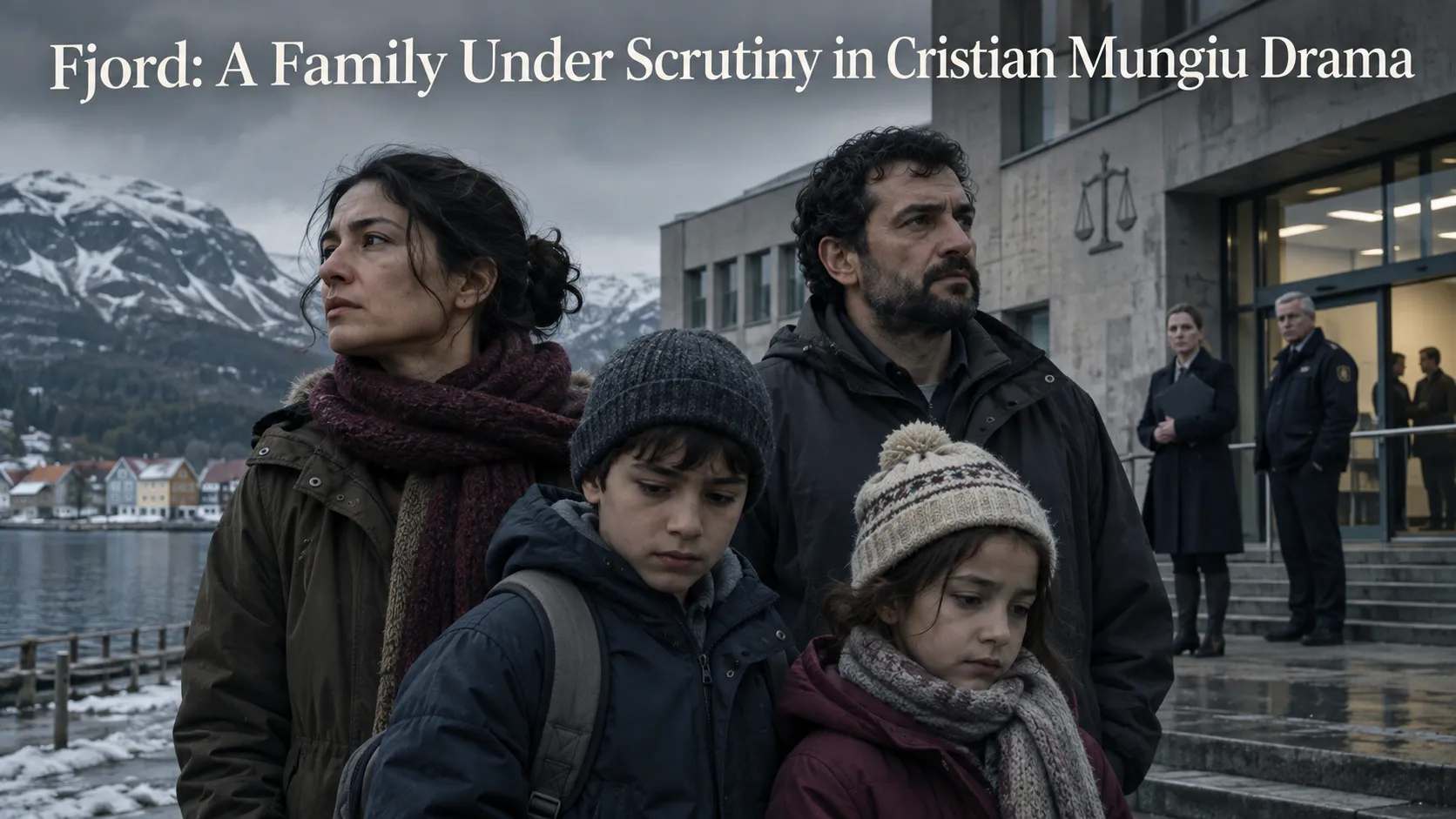
There has always been a strong sense of suspicion and fear when the values and traditions of different communities clash. Fjord is a 2026 European drama written and directed by Cristian Mungiu. The film is about a Romanian immigrant family who, after finding peace in Norway, become subject to suspicion of child abuse.
Through Mihai and Lisbet Gheorghiu, we see the collision of faith and the standards of the broader society. Their belief system requires them to raise their children in a certain way, and they move to a small fishing village in Norway in search of peace to raise their children according to their faith.
At first, people believe that they are a good addition to the community and the family’s positive spirit brightens the somber atmosphere in the wintry village.
In a short while however, people’s attitudes begin to shift as their methods of parenting come under greater public scrutiny.
Sebastian Stan and Renate Reinsve star in Fjord, and together they explore the variety of assumptions, personal beliefs and institutionalized authority which pits people against each other in apparently tranquil communities.
Fjord won the prestigious Palme d’Or at the 2026 Cannes Film Festival, and marks another accomplished work in the body of European cinema.
A Romanian Family In Norway
The Gheorghiu family moves from Romania to a Norwegian fishing village close to the fjords.
Mihai wants to bring his family to a country where they can embrace their practices freely and freely.
It is important for Lisbet and the kids to take comfort in their beliefs and raise their children according to their standards.
The family befriends the Halbergs and their children who are the same age, however this positive spirit soon fades when concerns about the Gheorghius methods of bringing up their children begin to occupy the minds of the people of the village.
While there may be differences in their upbringing and way of life, initially both families get along quite well.
Things change when Elia starts showing up to school with bruises on her body.
Teachers and members of the community start taking an interest in the marks and begin to wonder about the family’s disciplinary practices.
It isn’t long before someone intervenes.
People searching for English versions of international movies may get results for movie box old version apk download uptodown or similar apps, but such apps do not relate to this movie’s legal, authorized forms of distribution.
In the process, the family becomes entangled in a lengthy, complicated court process and a diminishing level of trust from the very people who had once welcomed them with open arms.
Sebastian Stan portrays Mihai Gheorghiu, a Romanian man with deeply-held religious convictions, who practices an unconventional form of family life.
Stan is also known for his work in the Marvel movies and other Hollywood productions.
The unconventional nature of Mihai’s family life and the legal system creates a struggle for Stan as he works to defend his family.
Renate Reinsve, plays Lisbet, Mihai’s Norwegian wife.
Lisbet’s past creates a crucial connection to the village where the family relocates.
Reinsve came to international prominence for her performances in The Worst Person in the World and Sentimental Value.
The supporting cast includes Lisa Carlehed and Lisa Loven Kongsli, and Christian Rubeck. A number of younger actors portray the children of both families.
The film gives a positive representation of families and the responsibilities that communities have toward the families that live within them.
Continuing the theme of moral uncertainty and power imbalances inherent in social and legal structures, Romanian filmmaker Cristian Mungiu explores a new story in Fjord.
Mungiu’s body of work includes such acclaimed films as 4 Months, 3 Weeks and 2 Days, Beyond the Hills, and Graduation.
Generally, his films center around characters struggling to navigate social and legal systems and concurrent ethical dilemmas.
Fjord depicts similar issues through the battle immigrant parents face when attempting to raise children within new cultural frameworks.
Mungiu’s production company includes Romania, France, Norway, Sweden, and Denmark.
Tudor Vladimir Panduru is the films’ cinematographer.
Panduru captures both the beauty of Norway and the isolation experienced by Mungiu’s characters.
Kaspar Kaae is the films’ musical score composer.
Mungiu refuses to simplify issues or draw moral judgments in Fjord and, instead, attempts to get audiences to reflect critically on their assumptions regarding cultural differences and the role of the state.
The film illustrates that while the state’s intentions may be good, the means and outcome may not always benefit the vulnerable person the state is attempting to protect.
Mungiu’s Fjord won the Palme d’Or at Cannes 2026.
The film also has a 146 minute running time and international recognition from the International Federation of Film Critics.
Norway released the film on September 4, 2026.
Fjord has a U.S. release date of October 9, 2026, through NEON.
Brazil will see the film on February 4, 2027, through Diamond Films.
Audiences searching movie applications may come across research for “movie box update app apk version“. Unofficial postings do not grant the right to distribute the applications.
Viewers are urged to contact the regional distributors for cinematic release for legal availability of the films.
Why Fjord Is an Important Contemporary Drama
Fjord shows us how the belief systems of individuals conflict with the expectations of the institution. Mihai and Lisbet feel they are upholding their responsibility as parents, and the people around them feel they are not protecting their kids.
The film takes a broader look at cultural assumptions, mistrust and the intrusive nature of officialdom.
Sebastian Stan and Renate Reinsve subtly convey the depth and complexity of the familial situation. Mungiu’s approach presents the difficulties of bridging the many dimensions of freedom and responsibility.
For fans of European cinema, this Award-winning film is a thoughtful exploration of moral dilemmas in family drama.